Showing posts with label Prison Librarians. Show all posts
Showing posts with label Prison Librarians. Show all posts
Tuesday, December 9, 2014
Dictionaries for Prisoners
Dictionaries are among the most requested items from prisoners. This is important because many inmates come to prison illiterate. The dictionaries help them with spelling, grammar, and the meaning of words when they write to family members on the outside, or as they try to get their GED. This year, Safe Street Arts is collecting dictionaries for indigent inmates. Check their website at: www.SafeStreetsArts.org


Monday, November 26, 2012
Prisoners Forum
The Prisoners Forum is a section of ALA ASCLA. It consists of a group of librarians who provide services to prisoners in adult and juvenile facilities. The group provides a great network services on line through the ALA website, Prison-L
At the summer conference in Anaheim, several librarians presented the program:
Nuts and bolts of building a public library and jail/prison partnership
For me it is always great to see colleagues from across the country who work in the same environment and have the same passion for special library services.
The photo shows presenters and participants at the ALA program in Anaheim, 2012


Saturday, April 14, 2012
Public Libraries and Ex Offenders
Inside the fence, the Prison Library is often the lifeline for prisoners who need information for their cases and for transition back into their communities. Most inmates say they never go to the public libraries when they are in the community. Yet they have children who attend schools and other family members who would benefit from the range of services in the libraries.
At the Maryland Library Association Conference in Ocean City in May, I will be one of the presenters for a workshop that will encourage public librarians to promote their services to soon to be released inmates and to ex offenders.
Title of the workshop is:
Returning Residents: Libraries and the Information Needs of Ex-Offenders.
My co presenters will be an employer of ex offenders and an ex offender who has successfully transitioned back to society and is working with at risk youths.
I will be highlighting the great model from Hennepin County Library FREEDOM TICKET
Some of the sites featured will include:
- National Resource Center
- Sites for housing, drug addiction, job hunt, family relations, community resources., etc
Monday, March 28, 2011
My Wish List
- The Dedicated Ex-Prisoner's Guide to Life and Success on the Outside: 10 Rules for Making It in Society After Doing Time. Richard Bovan
- Getting Out & Staying Out: A Black Man's Guide to Success After Prison, Demico Boothe
- Wiring a House 4th Edition: Completely Revised and Updated, Rex Cauldwell
- Letters to a Young Brother: MANifest Your Destiny. Hill Harper
- Cooked: From the Streets to the Stove, from Cocaine to Foie Gras. Jeff Henderson
- Eager Street: A Life on the Corner and Behind Bars. Arlando "Tray" Jones
- Best Jobs for Ex-Offenders: 101 Opportunities to Jump-Start Your New Life. Ron Krannich
- Chicken Soup for the Prisoner's Soul: 101 Stories to Open the Heart and Rekindle the Spirit of Hope, Healing and Forgiveness (Chicken Soup for the Soul) [. Tom Lagana
- The Other Wes Moore: One Name, Two Fates. Wes Moore
- Beyond Bars: Rejoining Society After Prison. Jeffrey Ian Ross
****
African American topics
- Africa: Mother of Western Civilization (African-American Heritage Series)Yosef ben-Jochannan. (Any book by this author)
- Selected Writings and Speeches of Marcus Garvey Marcus Garvey
- As Nature Leads: An Informal Discussion of the Reason Why Negro and Caucasian Are Mixing in Spite of Opposition. J. A. Roger
- E. Ethelbert Miller- Any poetry book by this author
- Rogers, A. J. Any book by this author
- They Came Before Columbus: The African Presence in Ancient Americ. Ivan Van Sertima
- The Mis-Education of the Negro. Carter Godwin Woodson
Self Exploration/psychology
- Beyond Anger: A Guide for Men: How to Free Yourself from the Grip of Anger and Get More Out of Life. Thomas J. Harbin
- Not in My Neighborhood: How Bigotry Shaped a Great American city [. Antero Pietila
- Rage: A Step-by-step Guide to Overcoming Explosive Anger. Ronald T. Potter-Efron
- Angry All the Time: An Emergency Guide to Anger Control. Ronald T. Potter-Efron
- Best Resumes and Letters for Ex-Offenders (Overcoming Barriers to Employment Success. Ronald Krannich
Books from the Jist catalog http://www.jist.com/shop/web
Monday, October 25, 2010
Blogs and news articles
Maryland Humanities Council's blogs about our participation in the One Maryland One Book on their web site. We had Warren St. John visiting Jessup Correctional Instit. It was a lively discussion.
Prison libraries have been in the news lately. I did an interview with Bob Edwards on the Bob Edwards Show, Serius XM radio earlier this month. The show aired on October 17. Avi Steinberg , was featured on an NPR program. He got rave reviews for his memoir, Running The Books: Adventures of an Accidental Prison Librarian.
We have our challenges as some states aggressively try to censor what inmates read. US & World News.
The battle continues. Fortunately we have organizations like the American Library Association and ACLU to help fight for prisoners rights to read.
Monday, October 11, 2010
Library Snapshot Day
Photographs are the property of the Division of Correction.
ECIW- 1 full time librarian and 8 inmate clerks had 108 visitors, checked out 29 magazines and 101 books, answered 55 general and 71 legal reference questions,18 inmates used the career center, 54 used computer databases, 48 books were repaired. There was1 book discussion with 11 patricipants and 1 facilitator.( Inmate population approx. 1200)
 |
| JCI inmates use legal and general databases |
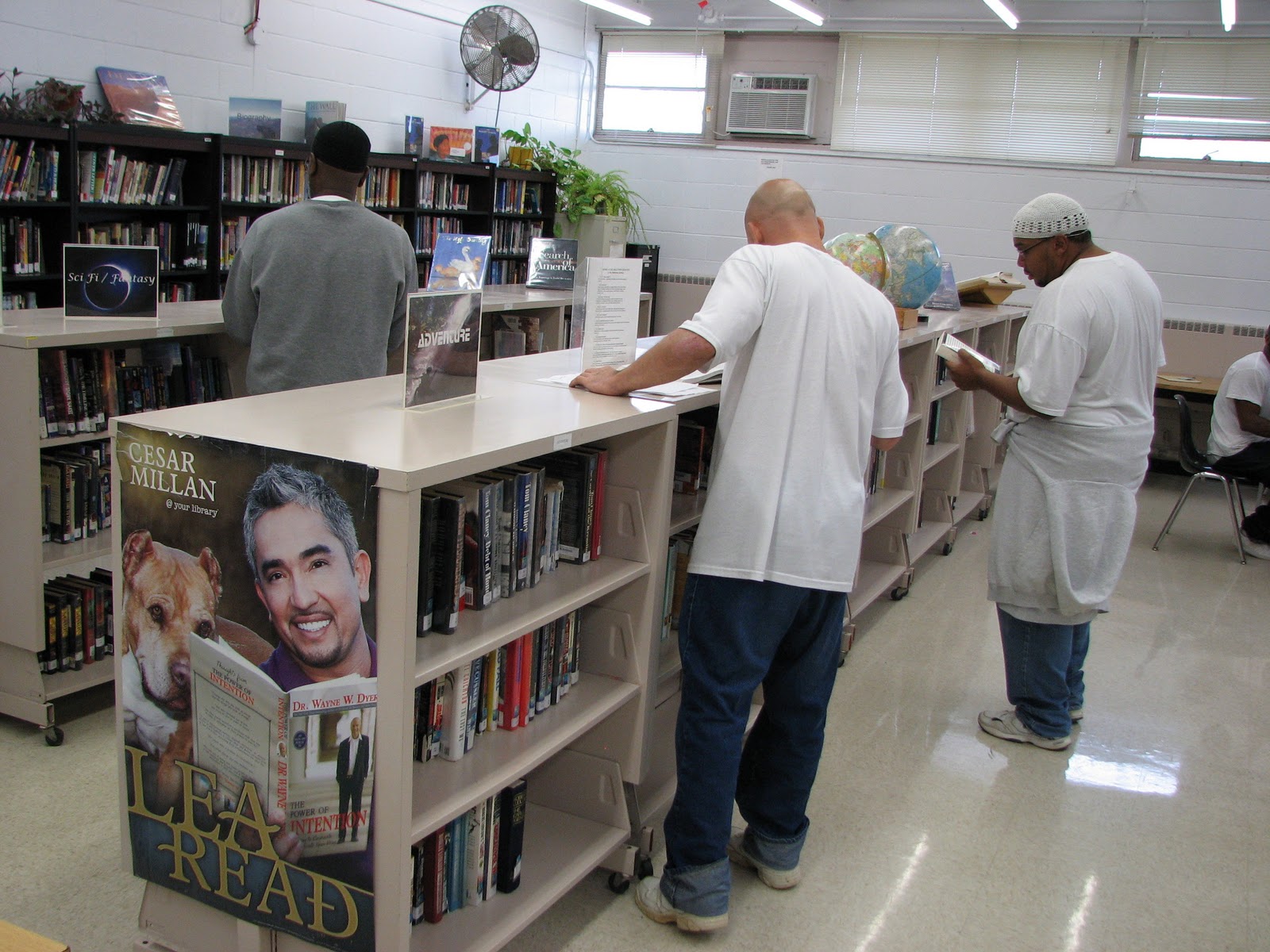 |
| MCTC inmates browse library shelves |
Three of the Maryland Correctional Prison Libraries participated in Library Snapshot Day. Jessup Correctional Institution (JCI), Maryland Correctional Education Training Center (MCTC), and Eastern Correctional Institution-West(ECIW). Statistics for that day:
MCTC with 1 full time librarian and 8 inmate clerks, had 162 patrons in the library, processed 75 items for inmates on segregation, checked out 83 magazines, and 86 books, answered 78 general and 60 legal reference questions. 8 inmates used the career center, 74 used computer databases. 48 students participated in the 2 education classes on library/reference instruction. 35 viewed CNN.(Total population- approx. 2,500)
ECIW- 1 full time librarian and 8 inmate clerks had 108 visitors, checked out 29 magazines and 101 books, answered 55 general and 71 legal reference questions,18 inmates used the career center, 54 used computer databases, 48 books were repaired. There was1 book discussion with 11 patricipants and 1 facilitator.( Inmate population approx. 1200)
 |
| Shirley Smith MCTC Librarian, assists library users |
 |
| Grace Schroder, Librarian, at JCI library information desk |
Thursday, September 16, 2010
The Prisoner and the Librarian
"Do the prisoners try to hit on you?" asked the public librarian who just told me with a shiver that she could never work in a prison library. I explained that in prisons the institution rules outline codes of conduct among staff and inmates. Of course not everyone follow those rules but there are consequences for deviants who get caught. She laughed when I told her my response to an inmate who one day told me how nice I looked. My response? I looked him in the eye and said, "In this place if you put a skirt over a mopstick, it would look nice to you". I then walked away from the inmate as I did not intend to engage in any personal conversation. Another inmate said he would be out of prison soon and could I give him my telephone number. I said as earnestly as I could. "Sure". 123 456 7890" He wrote it down then started laughing when he realized I was just counting from 1-10.
A great read on prisoner profile can be found in the book by Clark and McCreaigh, Library Services to The Incarcerated
Just read Judith Jordet's article on e books.
A great read on prisoner profile can be found in the book by Clark and McCreaigh, Library Services to The Incarcerated
Just read Judith Jordet's article on e books.
Friday, May 7, 2010
Prison Library Programs BIG READ

 Big Read Poster
 Grace Schroeder, Librarian JCI June Brittingham, Librarian, ECIW, Glennor Shirley, Library Coordinaotr
Maryland Correctional Education Libraries was the only prison that received an NEA award of the BIG READ. The kick off event at Eastern Correctional Institution (ECIW) and Maryland Correctional Institution Hagerstown (MCIH was covered in the Cumberland Times and DelMarva Times and the DPSCS web site program that centered around the book Fahrenheit 451, by Ray Bradbury.
Comments from inmates: "I learned that those in ultimate power use their power to control knowledge I truly appreciate the volunteer who gave his time, knowledge, and enthusiasm".
"I learned about the underlying current of the disposing of the process of book reading".
"The book discussion was a very positive experience and allowed intelligent conversation in an otherwise intellectually dampened environment".
"I learned about the importance of history and free thinking".
"I learned the importance of freedom of speech".
"The exchange of ideas was the best part of the group".
Saturday, February 13, 2010
Prison Library Questions
I get many questions from library school students who consider prison librarianship. Earlier in this blog (2008 blog archive)I have some FAQs. They may also get some insight from "Behind the Walls" column. The most recent question was from someone who had been incarcerated wanting to know if that would be an impediment to getting a job as a prison librarian. In Maryland it would be a problem as 2 years ago I tried to hire someone who had worked as a media specialist for over 20 years, but was caught with marijuana. No way said the DOC. I Would love to hear from other states.
Friday, August 7, 2009
Prison Librarians at ALA Conference
 Erica MacCreaigh presents a well attended program, "Do you belong in Jail?"

LSSPS dinner


Diana Reese auctions off socks. Erica paid to have a daring librarian wear it during the ASCLA COSLA reception. LSSPS fund raising effort towards the ASCLA Century Scholarship


Diane Walden was a good sport as she took up the challenge to wear the overtly displayed socks to the ASCLA COSLA reception. All part of the fund raising
Friday, June 26, 2009
Prison Librarian On The Move

 Moving Day for the adminsitrative offices of Correctional Education Libraries


Today was a tiring day. Correctional Education and Adult Learning programs were transferred from the Dept. of Education to the Division of Labor Licensing and Regulation (DLLR). It is a new environment for us as the dept. of Education had been our home since the 70s. The next few weeks our administrative offices will be unpacking and getting acquainted with new guidelines, staff, directors. I always find humor in things. This morning was no exception. The movers were unloading as I drove into the parking lot of my new work location.
After I parked the security guard came up to me. I thought I had parked in the wrong location as he approached with a tentative almost aprehensive look. He asked. " Are you part of the prison staff?" "Yes."I said pleased that he knew about us. " Will the prisoners be coming here?" I was too tired to say something clever like " Only the murders in orange suits." Instead I said no, the cage he saw up front was security for the GED office who transferred with us and who dealt with a lot of traffic from the public.
Monday, May 18, 2009
Prison Library Workshop


Prison Librarians and UNO instructors attending prison library workshop in Omaha, Nebraska

Recently I conducted a workshop for Nebraska prison librarians and library school students at the University of Nebraska, Omaha. The content of the workshop included, environmental scanning, collection development, prison gangs, and coping with daily issues in a prison. We toured a correctional facility in Omaha where inmates' access to legal materials is via the Internet, through one of the legal database vendors. The inmates have only Internet access to the legal database- nothing else. Prisoners online access to legal databases is likely the wave of the future for correctional libraries since most vendors are reducing paper and cd rom/dvd databases. Many prison administrators are nervous about this, but as this is a cheaper alternative, we hope most of them will come around before the end of the century. I enjoyed sharing my experience and passion with other professionals and with library school students. I received great feedback from the participants who appreciated that the workshop specifically addressed the issues pertinent to their situations. The feedback from the library school students was heartwarming. Some say they are now looking at prison librarianship as a career option. Hurray. We need new prison librarians to take over from those of us who are on the cusp of retirement.
Prison Librarians and The Library Community
Being a prison librarian can be isolating. In most cases there is not much interaction with librarians in other fields. I try to keep the Maryland prison libraries in the picture by encouraging librarians to get involved in the Maryland Library Association (MLA). Each year we participate in at least one program at their annual conference.
This year's program was titled. BOOK 'EM DANO. The presentation discussed programming, book discussions, and applying for grants. Last year our program was titled The Kinks Of Telecommuting Librarians. Our programs are usually well attended and we always leave time for questions. Although many of the questions are usually about the program, we always get and answer the ones that deal with safety.
This year's program was titled. BOOK 'EM DANO. The presentation discussed programming, book discussions, and applying for grants. Last year our program was titled The Kinks Of Telecommuting Librarians. Our programs are usually well attended and we always leave time for questions. Although many of the questions are usually about the program, we always get and answer the ones that deal with safety.
Wednesday, February 25, 2009
The Homeless have a Face
When I worked in the public library, there was a homeless man who spent his days in the library. As winter approached, he would deliberately commit minor infractions that landed him in the detention center for the winter I was responsible for outreach to the detention center, so I saw him in both places. The inmates called him Einstein because of his looks and because he was always reading.
One afternoon, I took a leave of absence from work so members of my congregation and I could feed the homeless. The homeless shelter was located in the vicinity of 6 prisons and one detention center. We prepared casseroles, desserts, and salads for approximately 40 persons.
Around 4pm, men and women of varying ages began arriving at the shelter. Before this, to me the homeless were bedraggled characters I saw on the street corner from my car window. Now their eyes looked into mine as they stretched out their plates, saying the food smelled good, that they wanted a taste of everything, and thanked us for giving them a home cooked meal.
They were nothing like I expected, they were clean, respectful, some displayed a sense of humor. The shelter had washing machine, shower, towels, a computer with internet access, a couch, a pantry with food, clothes, and lots of those little bottles of shampoo and hand lotion that we take away from hotel bathrooms.
They talked to one another, used the computer, did their laundry, got items from the pantry. As my congregation was clearing up, another congregation arrived to feed a new group of homeless persons. Some of the 4pm homeless had already thanked us and left to pass the night in their transient abode,- a church shelter, their cars, in a tent , on some outside grating, in the emergency room of a hospital, anywhere but a real home.
I wondered how many of them were ex offenders. The charity of stranger like the congregations is laudable, but I wonder when and if our taxes will ever be used to create treatment programs for addicts and ex offenders.
Tuesday, February 17, 2009
Just one of those days
What is a day if you can't laugh at yourself? Today is one of those days. I've been busy with trying to configure space and budget. On the phone with one of the prison librarians, I was calculating how many hours I need for substitute librarians for one of the prisons.
Twice the phone cut off. The first time the librarian and I said we did not know what happened. The second time it happened, I realized that I was using the telephone dial pad for a calculator!! No wonder the phone cut off.
"Time for you to go home", the librarian on the other end said amidst laughter, after I confessed I was the culprit.
As I said, it was just oneothosedays.
Thursday, August 7, 2008
Prison librarians


L. Standing. June Brittingham (ECIW), Glennor, Grace Schroeder(JCI),Mary Huebner,(NBCI) Mary Stevanus( MCIH, Charlie Albright(WCI), Liam kennedy(ECIE)
L back) Jean Charbonneau (mobile librarian), Jamar Young( computer tech), June Brittingham, Mary Stevanus,Grace SchroederFront: Lucy Berry (MCIW), Ruth Mewborn( MTC), Glennor Shirley, Beverly Bowles(Technology manager, Shirley Smith(clowning as usual) Nancy Liss(MCIJ)
Maryland Correctional Librarians get together on staff day when all correctional education staff gather for professional development. Outside the prisons, some librarians clown around saying that they are out on short term parole. The day provides an opportunity for networking, reducing the professional isolation for one day. Prison Librarians work as one person managers doing collection management, reference questions, supervising inmate workers, training inmates to use the databases, doing programs, and coping each day with the often arbitrary restrictions of the security staff. Inmates trust the librarians to help them find information and to get the books they like. Losses and behaviors are no different from what I encountered when I worked in public libraries. The advantage of working in the prison is that security staff are around to instantly address negative behaviors. For a list of the libraries and librarians see the Maryland Correctional Education Libraries website.
Saturday, July 19, 2008
Prison Librarians at ALA conference Anaheim


L-R
Diana Reese, Diane WaldenColorado, BJ Urling, Pennsylvania, Gilbert, Ohio
Anita Peterson, Diana Reese, Diana Walden
At the ALA conference around 66 persons listened to 4 prison librarians tell "inside stories"- the successful family literacy programs that are conducted inside the fence. I hope it inspires more public librarians to do outreach in this area, and more librarians who work in prison, to step outside the box, and take the extra step to provide family literacy events.
Saturday, May 31, 2008
Prison Librarians at MLA Conference

<< June B. Barbara Lipsky, web designer, Glennor, Shirley Smith, Librarian, MCTC, Beverly
Beverly Bowles, Technology Manager, June Brittingham ECIW, Liam Kennedy, ECIE

Each year, librarians who work in the Maryland Correctional Education Libraries attend and present a workshops at the annual conference of the Maryland Library Association. This helps to educate the library community on our work, so we do not feel so isolated. Our Librarians get together quarterly for training on various topics and to share.
Friday, May 16, 2008
Training Prison Librarians

 Two librarians from the Howard County Library conduct a training session on MYSTERY writers for Maryland prison librarians
Prison librarians work in isolation, so once per quarter, I organize a training session when the librarians come together. Location and topics vary. The meeting at the MD State Law Library discussed legal reference, the meeting at the Enoch Pratt Free Library included a tour of the job center and the African American Dept. Other sessions included Readers Advisory.
Thursday, February 28, 2008
FAQs for Prison Librarians
Q. How do I get to be a prison librarian:
A. It is best to have an MLS, and have some experience working in a public library setting. This gives the librarian a flavor for the variety and complexity of information and leisure reading needs of inmates- no different from non incarcerated persons. The successful prison librarian is willing and comfortable working with persons from diverse ethnic, socio economic , and educational backgrounds.
Q. Is it safe?
A. More crimes take place in malls, in the homes, in parking lots etc. than in prisons. The media create a lot of sensation with the stories about prisons. Majority of the prisoners are respectful, and appreciative of the services that advance their knowledge and education, and help them to be more successful when they reenter society .
Q. What do prisoners read?
A. Reading habits are similar to the public. Depends on their education level. If the librarian markets books, they will read beyond only what they know when they arrive in prison. See Behind the Walls
Q. Is there an Association or groups of prison librarians ?
A. ASCLA is a division of American Librarian Association. The Library Services to Prisoners Forum( LSPF) is part of the Library Services to Special Populations, a section of ASCLA. There is an active list serv of ALA - prison-l@ala.org. If you have questions, place it on the list serv and you will be sure to get many answers. LSPF usually meet at the ALA midwinter and summer conferences.
Q. What is a good book to read to prepare me for working in a prison library.
A. Library Services to Incarcerated... by S. Clark and E. MacCreaigh and Games Criminals Play, by Allen and Bosta. Another practical guide is Down For The Count, by Brenda Vogel
Q. Do prisoners have access to the Internet?
A. In most prisons, inmates do not have direct access to the Internet. Although the two major legal database vendors have introduced legal products that offer online access only to the legal database, this is not available in most prison libraries. Where prison librarians have the Internet, institution rules often limit them to using it only when inmates are not around. Their information needs are not always answered right away, but written down for a next day answer. I have an article on the topic at ALA/OLOS
Q. Are all prison libraries law libraries?
A. No. It is constitutionally mandated that inmates must have access to the courts. States differ in their interpretation and implementation. Some establish law libraries, others have legal clinics, yet others use a combination of legal reference in the libraries in addition to using another provider of legal services.
Q. How can I find a job in a prison library
A. Check out the Division of Public Safety job site in your state. Some public libraries do outreach in their local detention centers. You may start there.
Subscribe to:
Posts (Atom)